Examples and operator structure
Typical examples of FOR cycle, available in "COMPAS" are the following:
- FOR i := 1 TO 10 DO WRITELN(i);
- FOR i := 10 DOWNTO 1 DO s := s + i;
- FOR a[i] := 1 TO k DO BEGIN j := i + 1; a[j] := 2 * i END;
- FOR c := 'A' TO 'Z' DO d[c] := c;
- FOR b := FALSE TO TRUE DO BEGIN WRITELN(b); w := NOT b; WRITELN(w) END;
Possible structures of this operator can be written the following way:
FOR {cycle parameter} := {beginning value} TO {end value} DO {operator} ;
FOR {cycle parameter} := {beginning value} DOWNTO {end value} DO {operator} ;
Note, that instead of {operator} several operators,
confined between reserved words BEGIN and END - so called
compound statement - can be used.
The above variant with TO word is used when cycle parameter receives values
in growing order, with DOWNTO - in decrescent one.
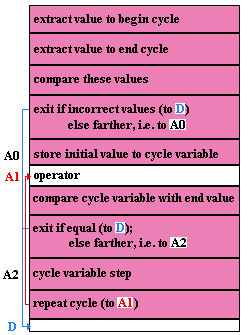 The construction under discussion has the following logic.
- Get the initial and the last number for cycle parameter.
- Compare them and skip cycle if they are incorrect to prevent
endless cycle
(FOR i := 10 TO 1 DO...)
- Only in the case of correct values (!) store the
beginning value into parameter variable.
- Execute cycle body.
- Compare cycle variable with end value and exit if they are equal.
- Calculate next value for TO and previouse one for DOWNTO.
- Repeat the cycle again.
As you can see from above, FOR construction constantly needs two values for operation
- current parameter and the last value for it. To proceed FOR cycle
"COMPAS" stores parameter address and end value in the stack.
Stack is a special way of memory organization. It requires a special
description.
Back to:





